New World Screwworm Resources
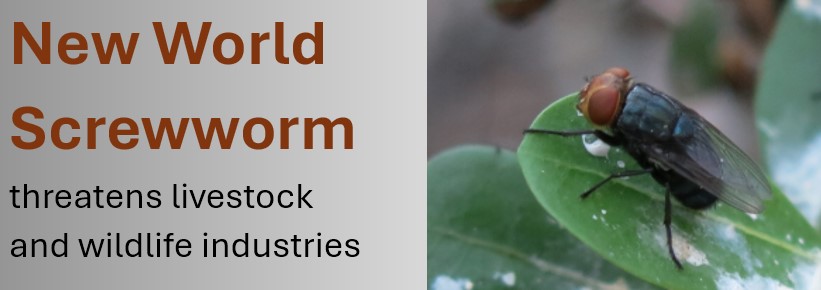
What is the New World screwworm?
The New World screwworm (Cochliomyia hominivorax) is a flesh-eating parasite that targets warm-blooded animals, including cattle, horses, sheep, goats, birds, wildlife and even pets.
Unlike other flies, the screwworm lays eggs near open wounds and mucous membranes. When the eggs hatch, the larvae burrow into living tissue, feeding as they grow, causing painful, often deadly wounds.
Once common across the southern U.S., the screwworm was eradicated from the country in the 1960s. But recent cases in Mexico have raised concern about the pest re-entering the U.S.
Identifying the screwworm
The name screwworm refers to the maggots’ feeding behavior. They burrow into the wound or tissue feeding as they go like a screw being driven into wood. Maggots cause extensive damage by tearing at the hosts’ tissue with sharp mouth hooks. The wound can become larger and deepen as more maggots hatch and feed on living tissue.
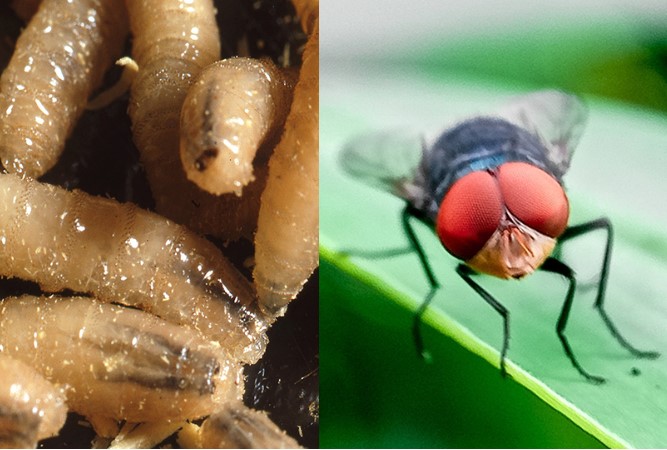
Adult screwworm flies are about the size of a common housefly. They have orange eyes, a metallic blue or green body and three dark stripes along their backs.
NWS larvae have a series of backwardly protruding spines around a tapered body, giving a screw-like appearance, helping to identify the pest.
Mexican livestock imports suspended
The U.S. Department of Agriculture (USDA) suspended livestock imports from Mexico to prevent the spread of the New World screwworm (NWS) into the U.S.
This suspension will continue on a month-by-month basis until a significant window of containment is achieved, according to USDA.
While the suspension poses economic and supply chain challenges, the potential devastation of a screwworm outbreak in Arizona and other parts of the U.S. would be far worse.
Where is the screwworm now?
A confirmed case of the New World Screwworm was recently detected in Texas on June 3. The detection occurred in a three-week-old calf near La Pryor in Zavala County.
Arizona remains well protected. The detection site in Zavala County, Texas, is more than 600 miles from Arizona. Surveillance efforts in the state have remained strong and unchanged since fly trapping began in August 2025. To date, Arizona has completed 73 rounds of surveillance and submitted 927 samples meeting submission criteria to the National Veterinary Services Laboratory for identification, with no New World screwworm flies detected in the state.
Learn more about this situation on the USDA NWS Outbreak in Central America webpage.
Protect your livestock
The New World screwworm is attracted to open wounds and mucous membranes where they lay their eggs.
Any wounds should be examined for an infestation of larval flies/maggots.
It is recommended to:
- Inspect livestock daily, especially around wounds, eyes, ears, nostrils, navels, and reproductive organs.
- Treat open wounds, scratches and scabs.
- Monitor newborn livestock and breeding stock closely.
- Inspect your clothing, boots, vehicles and equipment on your farm and ranch
Signs of an infestation
Signs of an NWS infestation may include:
- Fly larvae (maggots) in wounds
- Foul odor or smell of decay
- White or cream-colored runny substance (the eggs) in and around a wound
- Bloody or light-colored drainage from a cut or wound
- A cut or wound that rapidly worsens or grows
- Irritated or unusual behavior
- Head shaking
- Fever and other signs of secondary infection
- Reduced appetite
Reporting an infestation
Early detection and reporting are critical.
If you suspect a case:
- Isolate the animal.
- Contact your veterinarian.
- Report to the Arizona Department of Agriculture State Veterinarian, Dr. Ryan Wolker
- (602) 542-4293 (8AM – 5PM Monday through Friday)
- rwolker@azda.gov
Additional Resources
Arizona Department of Agriculture Resources
AZDA New World Screwworm Homepage
USDA Resources
USDA webpage on New World screwworm
New World screwworm emergency response
USDA Action Plan – NWS Domestic Readiness and Response Policy Initiative
USDA APHIS - Pesticides for New World Screwworm
University of Arizona Cooperative Extension: Arizona Livestock Incident Response Team (ALIRT) Resources
Texas Animal Health Commission (TAHC) Resources
New World Screwworm Fact Sheet
Emergency Management Guide
Texas A&M
New World Screwworm Webinar (June 9, 2025)
Latest News
USDA Confirms Presence of New World Screwworm in the United States (June 4, 2026)
USDA: Sec. Rollins Announces Plan to Combat NWS Northward Spread (June 18, 2025)
USDA: Update on Coordinated Federal Response to Protect United States from New World Screwworm (October 17th, 2025)